The Dictator's Handbook
read · season oneA ruthless model of how leaders acquire and retain power through incentives, coalitions, and loyalty. Its logic travels surprisingly well from governments to companies, boards, and institutions.

Belgrade · FEFA · every two weeks · reading in English
A book club for Belgrade students. Big ideas, real discussions, every two weeks at FEFA. Bring opinions.
"Your success in life will be determined largely by your ability to speak, your ability to write, and the quality of your ideas."
Patrick Winston, MIT

Luka Babic · founder of the club
I started this book club for a selfish reason: I wanted to read more. And, perhaps more importantly, I wanted to remember more of what I read.
Reading alone is easy. Holding on to an idea, however, is harder. I've found that the books that stay with me are usually the ones I've had the chance to argue about, question, connect to something else, or hear interpreted through someone else's eyes.
So I suggested we start a book club at FEFA, and a small group of students decided to read with me.
We began simply: one book at a time, a room full of curious people, and a conversation every two weeks.
After our first season, it felt worth opening the table to others.
The books we choose are the kinds of books you might find on a CEO's desk, a professor's shelf, or in the hands of someone trying to better understand how the world works. We are not interested in idolizing CEOs or today's leaders. We are interested in understanding what they read, which ideas shape the way they think, and how those ideas, in turn, shape the world we all live in.
And when we can, we invite professors, practitioners, authors, business leaders, and other interesting voices to join us at the table.
The groups stay small: 10 to 16 people. We meet every fortnight, in person, and everyone is expected to have something to say.
If you know a student who wants to read more, finds these books interesting, thinks more carefully about what they read, and remembers more by discussing it with others, send them our way.
There's always room for another good reader.
Members shortlist from The List below and vote on what we read next. Your club, your syllabus.
Small facilitated tables. No lectures, no professors, no wrong answers.
A few days later, the Margin Notes land in your inbox: what we argued about, what we kept.
Didn't finish the book? Come anyway.
The first 20 minutes catch you up.
Seats are capped at 16.
Bigger night? We run a fishbowl: an inner circle debates, the outer circle listens, and people rotate in.

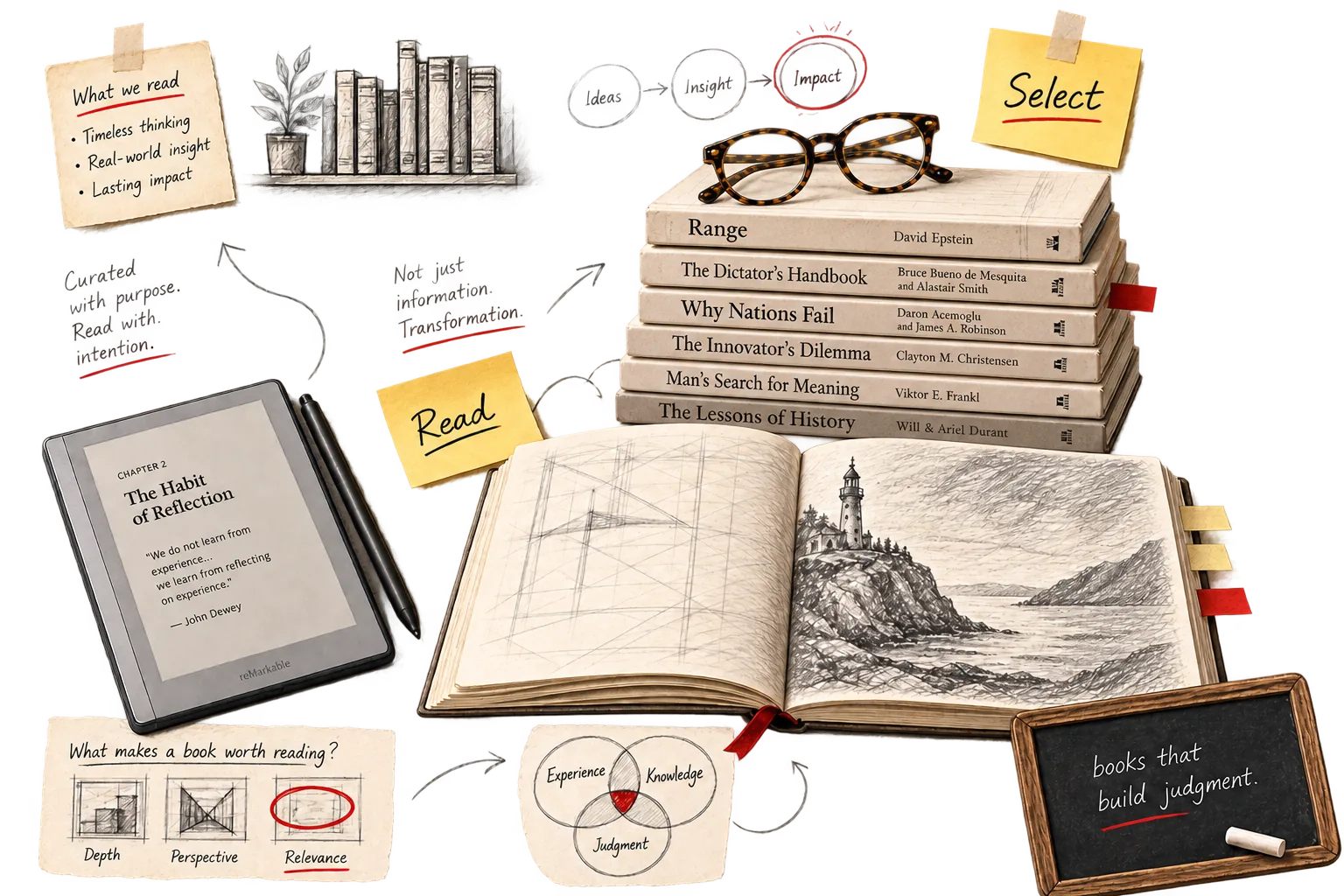
Fifty books about power, technology, organizations, human nature, judgment, and the ideas that shape the people shaping the world. Read in any order; argued about in ours.
A ruthless model of how leaders acquire and retain power through incentives, coalitions, and loyalty. Its logic travels surprisingly well from governments to companies, boards, and institutions.
An insider's critical account of Facebook turns abstract questions about corporate responsibility into decisions made by identifiable people inside one of the world's most powerful organizations.
Technology does not automatically create broadly shared prosperity. Institutions, incentives, and power determine who benefits from technological change. A crucial framework for thinking about AI.
Asks how much inequality is natural and how much is created by political, cultural, and institutional choices. A compact way into one of the defining questions of modern capitalism.
Connects economic insecurity, technology, weakened institutions, and declining political legitimacy. Particularly relevant for a generation experiencing populism, protest, and institutional distrust firsthand.
Makes institutions central to explaining why some societies become prosperous while others stagnate. Its thesis is intuitive enough to grasp immediately and ambitious enough to debate for hours.
Explores how information abundance destroys institutional authority faster than new institutions can replace it. Highly relevant to social media, decentralized protest, and contemporary political movements.
Shows how institutions simplify complicated human systems in order to measure and control them, often with disastrous unintended consequences. The framework applies equally well to companies, metrics, and algorithms.
The Haitian Revolution becomes a study of leadership, culture, ideology, and institutional change under extreme conditions. It takes leadership discussion far outside the conventional business canon.
A realist theory of elites, institutions, and power beneath official political narratives. A natural intellectual successor to *The Dictator's Handbook*, but from a different tradition.
Connects quantum physics, evolution, computation, and epistemology into one attempt to explain reality. Difficult, but exactly the kind of book capable of changing the framework through which someone sees problems.
Makes a radical case for explanatory knowledge, optimism, and the proposition that problems are soluble through better explanations. It turns progress itself into a philosophical question.
Science fiction becomes a laboratory for thinking about civilizational decline, prediction, institutions, and whether exceptional individuals can alter the course of history.
Uses science fiction to explore scientific progress, existential risk, strategic uncertainty, and humanity's reaction to a civilization operating on a completely different technological scale.
The source of the modern idea of a paradigm shift. It asks whether progress really occurs gradually, or when an old explanation can no longer accommodate what we observe.
Bell Labs becomes an experiment in how institutions produce breakthroughs. What mix of extraordinary people, freedom, resources, collaboration, and patience actually creates innovation?
Semiconductors connect scientific progress, industrial policy, geopolitics, national security, and corporate strategy. It exposes the physical infrastructure underneath the supposedly intangible digital economy.
One of the builders of modern AI asks whether increasingly capable AI and biotechnology can actually be contained. It places technological ambition directly against questions of governance and control.
A critical account of frontier AI, its ideology, capital requirements, and concentration of power. Useful precisely because it challenges the narrative technology companies often tell about themselves.
A data-driven explanation of the physical systems beneath modern civilization: energy, food, materials, globalization, and the environment. A corrective to technological thinking that ignores physical constraints.
Challenges the mythology of the lone creative genius and argues that breakthrough ideas emerge through exploration, recombination, and focused development. Drawing on examples from science, art, film, and business, it asks a central question for any innovative organization: can creativity be made more systematic?
A rigorous attempt to define what managers actually do: leverage, meetings, teams, output, and performance. Useful for comparing systematic management with contemporary ideas about founder-led companies.
Pixar becomes a laboratory for designing organizations where talented people can challenge one another, recover from failure, and repeatedly create rather than merely getting lucky once.
A firsthand account of customer obsession, frugality, experimentation, and operating discipline. It allows comparison between pre-internet retail entrepreneurship and today's platform businesses.
One of the better antidotes to retrospective founder mythology. Nike's creation appears uncertain, cash-starved, and contingent rather than an inevitable journey toward greatness.
A business novel built around one powerful idea: optimizing every component does not necessarily optimize the system. Bottlenecks, constraints, and throughput become surprisingly intuitive.
Reframes the CEO's job around capital allocation rather than charisma or management fashion. Eight unconventional CEOs become competing answers to the question of what a CEO actually controls.
A concise firsthand account of leading Disney through Pixar, Marvel, Lucasfilm, and major technological disruption. Particularly useful for discussing judgment, acquisitions, creative organizations, and succession.
Explains the paradox that excellent management can cause successful companies to miss disruptive change. One of the most useful frameworks for understanding incumbent failure.
Business told through messy human stories rather than formulas. Product failures, markets, incentives, communication, and organizational behavior remain strikingly recognizable decades later.
Challenges early specialization and argues for breadth, experimentation, and analogical thinking in unpredictable environments. Particularly relevant to students being asked to specialize before they have explored enough.
A collection of conceptual tools for testing arguments and exposing bad reasoning. The deeper question is whether mental models illuminate reality or sometimes trick us into believing we understand it.
Treats failure as information. By contrasting systems that investigate mistakes with those that conceal them, it opens a direct discussion about learning cultures and experimentation.
Gives readers a language for feedback loops, delays, leverage points, and unintended consequences. Organizations and societies rarely behave as neatly as their formal structures suggest.
Tests whether judgment about uncertain futures can actually be trained. A practical antidote to charismatic certainty and an excellent introduction to probabilistic thinking.
Builds decision-making around mental models borrowed from psychology, economics, mathematics, and science. Its central claim is that breadth across disciplines produces better judgment.
Goes beyond resilience to ask which systems actually improve through volatility. Useful for thinking about companies, careers, markets, and why eliminating uncertainty can sometimes make systems weaker.
More than an investing manual. It is about distinguishing price from value, emotional discipline, and learning to behave rationally when markets do not.
Challenges the assumption that Western psychology is universal and traces how institutions may have reshaped cognition, families, and individualism. A bridge between psychology, anthropology, and economics.
Curiosity as an operating system. Feynman's stories model skepticism of authority, joy in discovery, experimentation, and the desire to understand something for oneself rather than merely know its name.
Satire as social psychology. Status, imitation, taste, and small performances of belonging reveal behaviors that remain recognizable inside modern organizations and professional communities.
Mimetic desire suggests that we learn what to want by observing what others want, creating imitation, competition, rivalry, and scapegoating. A powerful lens on markets, status, organizations, and politics.
Long before social media, Postman argued that the medium through which information reaches us changes what a society is capable of thinking about seriously. A natural intellectual sequel to *The Anxious Generation*.
A generational argument about smartphones, social media, childhood, and mental development. Its strength in the club came from students being able to compare the thesis directly with their lived experience.
Explores how religion, family, property, and social institutions created ancient societies. Difficult, but capable of changing the categories through which a reader understands culture and institutions.
Meaning under extreme conditions becomes a larger discussion about agency, suffering, narrative, and what human beings require in order to continue moving forward.
Rejects the fantasy that productivity will eventually allow us to do everything. For ambitious students and executives, time management becomes the much deeper question of what deserves a finite life.
A novel about duty, professional identity, missed choices, and regret. It asks a question management literature rarely asks: what if extraordinary devotion to work produces a life one would not choose again?
Opens the shelf to spirituality, intuition, and non-Western intellectual traditions. It is particularly interesting as part of the intellectual genealogy of one of modern technology's defining founders.
A remarkably short attempt to distill recurring forces across history: war, inequality, economics, religion, government, and human nature. Very little reading for a potentially enormous discussion.
six shelves, fifty spines, one table ↑ scroll the shelf
Every other week, 18:00, at FEFA, Karađorđeva 65. Seats are capped at 16; the live count and waitlist run on Luma. Reserve and you'll get the confirmation, the reminder, and the first question by email.
bigger group that night? fishbowl setup: inner circle talks, outer circle listens, everyone rotates in

can't make it after reserving? free the seat on Luma so the waitlist moves
Leave your email and we'll let you know when the next book and date are set.